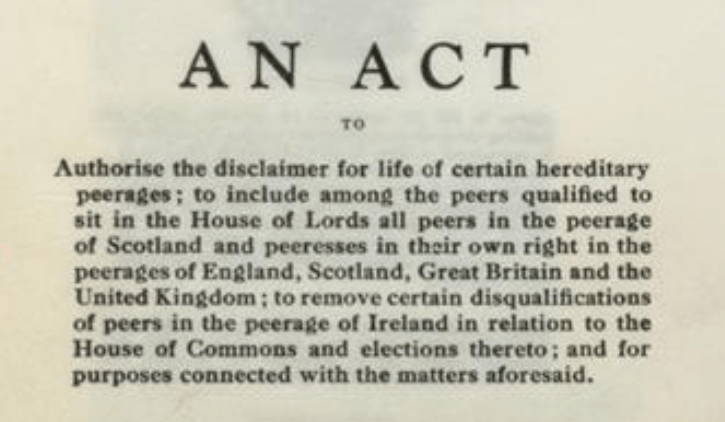
When a peerage has been disclaimed, no other hereditary peerage may be conferred. Most recently Lord James Douglas-Hamilton, Member of Parliament for Edinburgh West, succeeded as 11th Earl of Selkirk on 23 November 1994 and disclaimed this title for life five days later in order to keep his seat in the House of Commons. When he gave up his parliamentary seat in 1997 he was created a life peer as Baron Selkirk of Douglas.
As soon as a peer has disclaimed his peerage he reverts to the status held before he inherited the title, and he is not accorded any courtesy title or style that he previously possessed deriving from that peerage. Even though he disclaims the peerage within a few days after succession, he must first have succeeded as a peer immediately on his predecessor’s death, and for that interval he will feature in the numbering in works of reference, eg 11th Earl of Selkirk.
Should he also be a baronet or knight, these dignities and appropriate styles are retained, being unaffected by his disclaiming the peerage. A life peerage cannot be disclaimed.
Immediately after her husband disclaims his peerage she reverts to the same style as her husband. For example, if he becomes Mr John Jones she becomes Mrs John Jones (or Mrs Jane Jones if she prefers). If her husband is also a baronet, or has been knighted, she may use the title of ‘Lady Jones’.
Similarly, if she has a title in her own right, as the daughter of a peer, she may revert to its use (ie ‘Lady Mary Jones’, or ‘The Hon Mrs Jones’).
The children of a disclaimed peer retain their precedence as the children of a peer, and any courtesy titles and styles borne while their father was a peer. It is open to any child of a disclaiming peer to say that he or she no longer wishes to be known by these styles, eg the two sons and two youngest daughters of the late Victor Montagu (disclaimed Earl of Sandwich) decided to retain their titles, but his two eldest daughters decided not to. All the children of the late Tony Benn (disclaimed Viscount Stansgate) decided to drop their courtesy titles.
There is a long, and interesting, list of peers who have disclaimed their titles since Tony Benn led the way on 31 July 1963. Among others are John Grigg (2nd Baron Altrincham), who was a columnist for the Guardian and The Times; Sir Max Aitken (2nd Baron Beaverbrook), chairman of Beaverbrook Newspapers; Sir Hugh Fraser (2nd Baron Fraser of Allander), chairman and managing director of the House of Fraser; Quintin Hogg (2nd Viscount Hailsham), Lord Chancellor, who returned to the House of Lords as a life peer; Sir Alec Douglas-Home (14th Earl of Home), Prime Minister, who also returned to the House of Lords as a life peer; Tony Lambton (6th Earl of Durham); William Collier (4th Baron Monkswell); Victor Montagu (10th Earl of Sandwich); Charles FitzRoy (5th Baron Southampton); George Archibald (2nd Baron Archibald); Lord Hartwell (Michael Berry), who succeeded his brother as 2nd Viscount Camrose, but had already been created a life peer in 1968.